






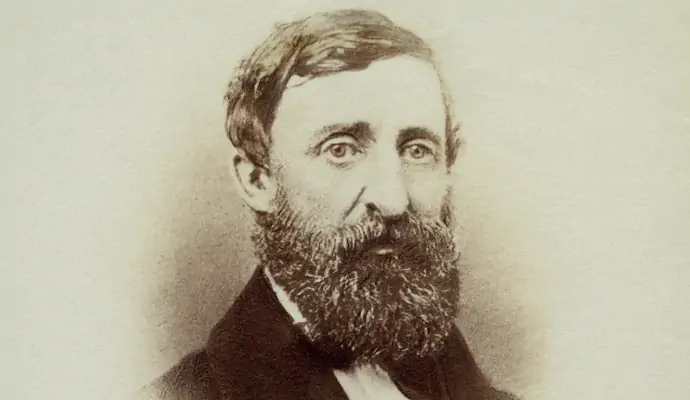
“And I am sure that I never read any memorable news in a newspaper.” The transcendentalist movement is centuries old now, and alongside it is one of its core founders, Henry David Thoreau. This same Thoreau ventured alone into the woods of Walden Pond in order to discover the “marrow” of life itself, the essence of existence. But he also had a great deal of political hot takes(for the time), such as his opposition to both slavery and the Mexican-American War.
Among these viewpoints, he has a stark opposition to the idea that news is useful to someone who lives deliberately. His reason is sort of simple, sort of not:
“If we read of one man robbed, murdered, or killed by accident, or house burned, or one vessel wrecked, or one steamboat blown up, or one cow run over on the Western Railroad, or one mad dog killed, or one lot of grasshoppers in the winter,– we never need read of another. One is enough. If you are acquainted with the principle, what do you care for a myriad of instances and applications.”
Essentially, Thoreau believed that news never said anything new, and that it is a repetition of a set of instances, for example, a murder or a train accident, and that once you’d seen one, you’d seen them all. But what lies at the core of his idea is that the news teaches us to react instantly, to build a habit of forming opinions on the spot. We see a headline and we already know what to think, you need not look further than the caption on a photo to see exactly what a news page wants you to think. And to Thoreau, looking further than the headline will only get you more of the same: just the same event flavored differently based on how the current power construct wants you to feel.
So is he right? Is your reading of this article evidence that your day is not being seized? In a word: no. In many words: news isn’t just about what is happening. In Thoreau’s time, it is certain that local newspapers would not have much material to print that wasn’t just more of the same, and that the only relevant data would be an occasional war or crisis. But now, people are being ripped out of homes, killed in the streets, and over a trillion animals are killed for profit every year. These aren’t new by any stretch of imagination or logic, but they are absolutely preventable if only we may be informed. And news doesn’t always do its job well, but nowadays there are resources like Ground News, and fact checkers left and right, and so while bias and prejudice still exist, they are not unchecked, and these checks are not out of reach.
All told, news is just like any other tool, useless in the hands of those who are not trained to wield it. But in the hands of a skilled consumer, and with the help of other resources, news is the foremost defense against darkness in the world, it is a lighthouse in an otherwise shrouded sea, and it is the first(and often only) line of defense against that which threatens our humanity and our capacity to remain connected to the political and social landscapes of the world.

